
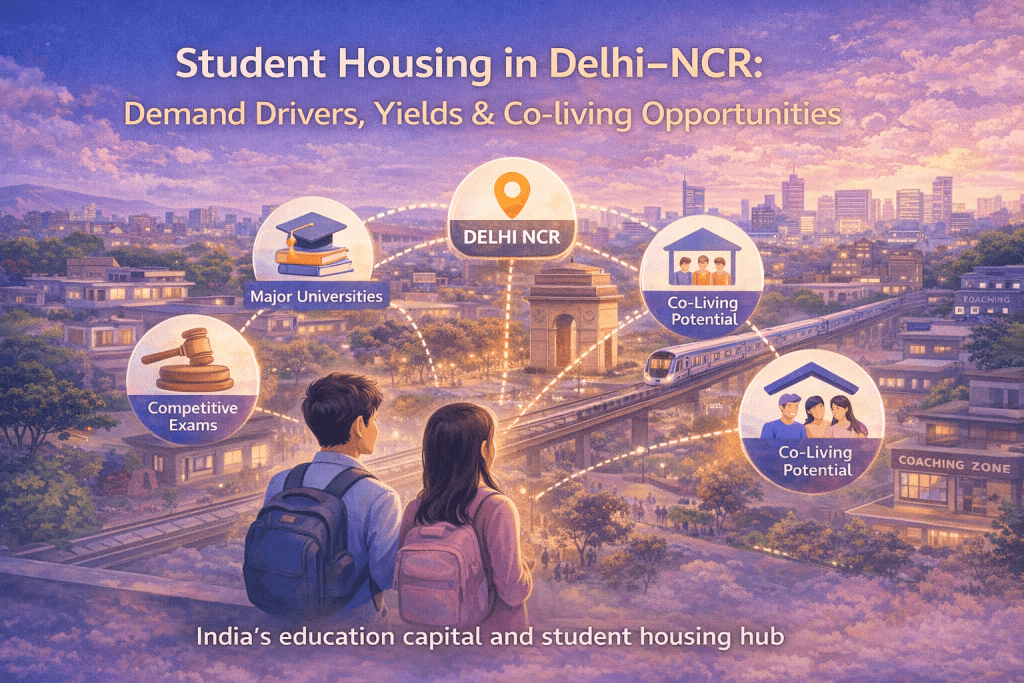
Delhi–NCR is not just India’s capital region — it is one of the country’s deepest and most resilient student ecosystems. What makes this market unique is not a single university or discipline, but the sheer diversity of academic demand flowing into the region every year.
For student housing operators and long-term investors, Delhi–NCR represents a market where consistency beats speculation and connectivity beats luxury.
At HooLiv, we see Delhi–NCR as a city-region that rewards patience, operational discipline, and smart micro-market selection.
Why Delhi–NCR Attracts Students from Across India
Delhi–NCR draws students for three core reasons: choice, opportunity, and access.
Unlike single-discipline cities, the region offers:
- Central universities
- Premier law and humanities institutions
- Management schools
- Government and private colleges
- One of India’s largest coaching ecosystems
Students arrive not only for degrees, but also for:
- Competitive exams (UPSC, judiciary, CA, CLAT, CAT)
- Research programs
- Skill-based certifications
This creates year-round demand, not just seasonal academic cycles.
From a housing perspective, this diversity reduces dependency risk. When one segment slows, another fills the gap.
Academic Clusters That Drive Housing Demand
Delhi–NCR’s strength lies in academic clustering, not isolated campuses.
Key Demand Anchors Include:
- Delhi University (North & South Campus) – UG & PG students across disciplines
- Law colleges & judiciary prep hubs – Long-stay, exam-focused cohorts
- Management & private universities – NCR and Greater Noida belt
- Coaching zones – Mukherjee Nagar, Karol Bagh, Laxmi Nagar, Noida
Each cluster creates a slightly different housing behavior — and understanding this is critical for operators.
Student Housing Demand Patterns in Delhi–NCR
Delhi–NCR hosts one of the widest mixes of student profiles in India.
1. Undergraduate Students (UG)
- Price-sensitive but location-driven
- Prefer shared rooms near campuses
- High dependence on public transport
2. Postgraduate & Research Students (PG)
- Longer stays
- Higher preference for privacy and stability
- Willing to pay more for convenience and safety
3. Competitive Exam Aspirants
- Extremely location-specific
- Longer average stay (12–24 months)
- Strong preference for quiet, structured living
This mix ensures consistent occupancy, even when traditional academic calendars fluctuate.
Micro-Markets That Work Best for Student Housing
Delhi–NCR is not a single market — it is a collection of micro-markets. Choosing the right one matters more than choosing the right building.
1. Metro-Linked Zones
Areas with direct metro access consistently outperform others.
Why?
- Students prioritise commute certainty
- Metro access widens the catchment area
- Parents view metro connectivity as a safety factor
2. North & Central Delhi
- Dense academic and coaching clusters
- Limited land supply
- Older buildings, but unmatched demand depth
These markets reward renovation and management quality rather than new construction.
3. Noida & Greater Noida Pockets
- Growing university clusters
- Planned infrastructure
- Better scope for purpose-built student accommodation (PBSA)
These zones suit larger-format, professionally managed assets.
HooLiv Insight: Stability Wins in Delhi–NCR
In markets like Delhi–NCR, we see stability outperform aggressive pricing. Assets near metro lines consistently maintain over 90% occupancy — even during off-cycles.
From our experience, Delhi–NCR does not reward speculative pricing.
It rewards:
- Proximity
- Predictable service
- Clean operations
- Transparent policies
Students here stay longer when daily friction is removed — not when luxury is oversold.
Expected Returns & Key Risk Factors
Return Characteristics
- Rental yields: Moderate to strong
- Occupancy: High when micro-market selection is right
- Cash flow: Stable, predictable
Unlike volatile residential rentals, student housing benefits from academic inevitability — students will keep coming.
Risk Factors to Watch
- Overpaying for poorly connected locations
- Ignoring regulatory compliance
- Treating student housing like standard residential leasing
- Underestimating operational intensity
Delhi–NCR rewards operators, not passive landlords.
Co-living & PBSA Opportunities in Delhi–NCR
Co-living and PBSA models are gaining traction, especially in:
- Noida
- Greater Noida
- Transit-oriented corridors
What works best:
- Functional design over luxury finishes
- Clear rules and professional management
- Flexible room configurations
Students here value reliability more than aesthetics.
Is Delhi–NCR Right for Operators or Long-Term Investors?
Delhi–NCR is ideal for:
- Long-term investors seeking stable cash flows
- Operators with strong on-ground execution
- Brands focused on trust, safety, and consistency
It may not suit:
- Short-term speculative investors
- Passive owners without operational bandwidth
This is a mature student market — and maturity rewards discipline.
Final Word from HooLiv
Delhi–NCR doesn’t promise overnight returns.
What it offers instead is durability.
In student housing, durability matters more than hype.
For those willing to build patiently, operate professionally, and choose micro-markets wisely — Delhi–NCR remains one of India’s most dependable student housing markets.