
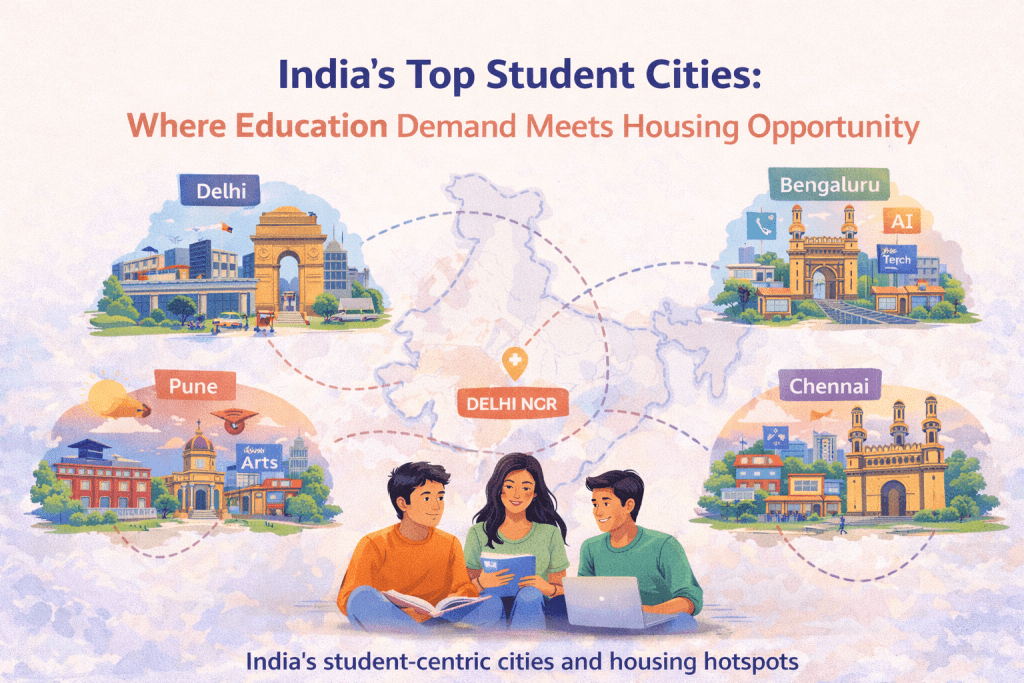
India’s student housing story is no longer limited to a few legacy education centers. Today, it’s shaped by academic clustering, mobility of students, institutional expansion, and changing lifestyle expectations.
At HooLiv, we don’t look at cities only through rankings — we look at demand depth, consistency, and livability. This pillar guide breaks down India’s strongest student hubs by field of study, housing behavior, and return potential, helping operators and investors make informed decisions.
Why Student Housing Is Becoming a Standalone Asset Class
Traditional residential rentals typically yield modest returns and face high vacancy risks. Student housing, on the other hand, benefits from:
- Predictable academic cycles
- Constant inflow of outstation students
- Higher per-bed yield models
- Lower emotional vacancy (students must stay close to campus)
This is why well-managed student and co-living assets consistently outperform conventional rentals.
Delhi–NCR: India’s Most Diverse Academic Ecosystem
Best for:
Management, Law, Humanities, Social Sciences & Mixed Programs
Delhi–NCR thrives on academic diversity. From central universities and law colleges to private management institutions, the region attracts students from every part of the country.
What makes it strong:
- Large outstation student population
- Excellent metro and public connectivity
- Year-round academic demand (UG, PG, coaching, research)
Housing insight:
Student housing here works best near university clusters, metro corridors, and coaching hubs. Stability matters more than aggressive pricing — occupancy stays strong when access is seamless.
Bengaluru: The Engineering & Research Powerhouse
Best for:
Engineering, Computer Science, Technology & Research
Bengaluru sits at the intersection of education and industry. Students don’t just come here to study — they come to build careers.
What makes it strong:
- Presence of top research institutions
- Tech ecosystem fuels internships and extended stays
- High acceptance of co-living formats
Housing insight:
Students here value connectivity, privacy, and flexibility. Purpose-built, well-managed assets outperform traditional PGs significantly.
Pune: India’s Most Balanced Student City
Best for:
Engineering, Management, Arts & Commerce
Pune stands out because it isn’t dependent on one discipline. Its strength lies in volume, balance, and affordability.
What makes it strong:
- Dense concentration of colleges across micro-markets
- Massive outstation population
- Student-friendly culture and cost structure
Housing insight:
Proximity wins in Pune. Assets close to campuses command premium rents and near-zero vacancy. This makes Pune one of the most operator-friendly cities in India.
Chennai: Stability Driven by Engineering & Medical Education
Best for:
Engineering, Medical Sciences & Research
Chennai is not flashy — and that’s exactly its strength. It offers deep-rooted academic institutions and consistent enrollment year after year.
What makes it strong:
- Long-standing reputation in technical and medical education
- Strong regional and national student mix
- Longer average stay durations
Housing insight:
Students here prefer structured, disciplined living environments. Clean, well-managed housing with food and study-friendly design performs best.
Hyderabad: Where Engineering Meets Business Education
Best for:
Engineering, Business, Healthcare & Emerging Tech Programs
Hyderabad has quietly evolved into a multi-disciplinary education hub, supported by a growing corporate ecosystem.
What makes it strong:
- Nationally relevant institutions
- Increasing migration from North & West India
- Strong linkage between education and employment
Housing insight:
Demand clusters sharply around institutional zones. Co-living formats work well for senior students and post-graduate cohorts.
Medical Education Hubs: High Stability, Niche Premium
Key cities include:
Delhi, Pune, Chennai, Bengaluru, Vellore, Chandigarh
Medical education creates one of the most resilient housing demands in India.
What makes it unique:
- Long course durations
- Intensive academic schedules
- Strong preference for quiet, secure accommodation
Housing insight:
Purpose-built housing near medical campuses commands premium rents and extremely stable occupancy — especially where quality supply is limited.
Tier-2 & Emerging Student Cities: The Next Growth Wave
While Tier-1 cities offer scale, Tier-2 cities offer acceleration.
High-potential markets include:
Greater Noida
- Rapid institutional expansion
- Planned infrastructure
- Excellent scope for large-format student housing
Jaipur, Lucknow, Indore
- Growing student migration
- Affordable entry costs
- Improving academic reputation
Coimbatore, Mysore
- Strong engineering and research focus
- Smaller but highly consistent demand cycles
- Limited organized housing supply
Housing insight:
These cities offer higher yield potential when assets are professionally managed and positioned close to campuses.
Student Housing ROI: What the Numbers Really Tell Us
Across India, student housing typically delivers:
- Higher yields than traditional residential rentals
- Better occupancy stability
- Faster scalability through per-bed models
Purpose-built student accommodation (PBSA) consistently performs best due to:
- Predictable leasing cycles
- Premium pricing for convenience and safety
- Strong word-of-mouth demand
HooLiv’s Take: Where the Smart Money Is Going
At HooLiv, we believe the future belongs to operators who understand micro-markets, not just cities.
The strongest opportunities lie where:
- Institutions are dense
- Students are mobile
- Quality housing supply is limited
- Management, not just construction, drives value
Student housing isn’t a short-term play. It’s a long-cycle, high-discipline asset — and when done right, it delivers both impact and returns.