
A founder’s perspective from the ground
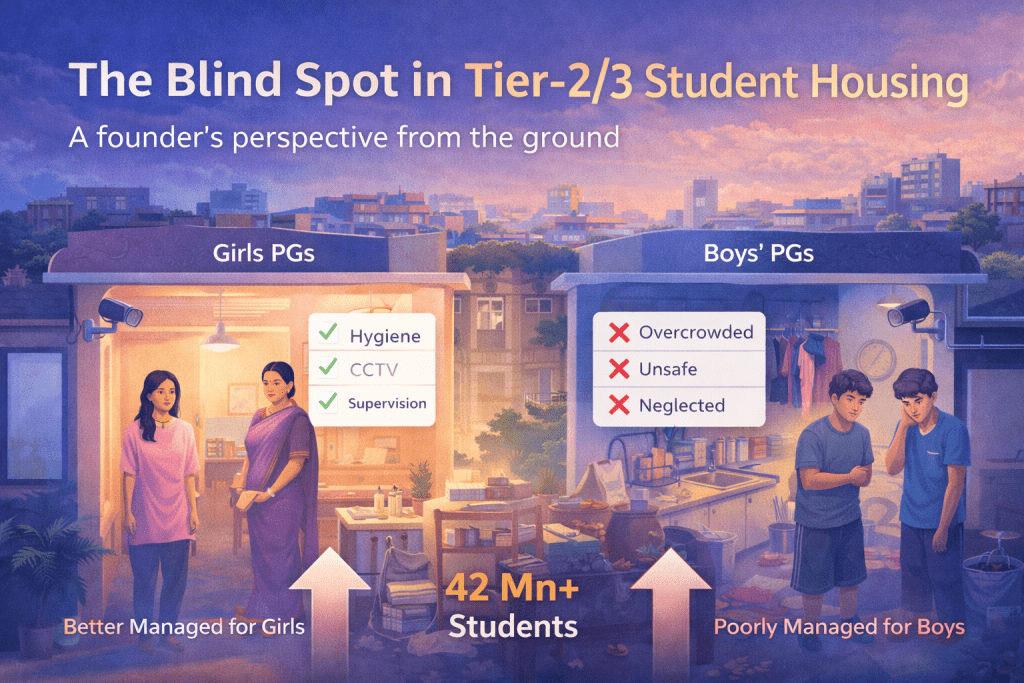
During a recent visit to Bhopal, I spent time informally reviewing PGs and hostels across multiple localities. What stood out immediately was the sharp contrast between accommodation for girls and boys.
For girls, I found relatively better-managed PGs—structured rules, basic hygiene, CCTV coverage, wardens, and clearer operating norms. For boys, however, the story was very different. Most PGs were unorganised, overcrowded, poorly maintained, and run with minimal accountability. In many cases, sanitation, safety, and even basic dignity of living were compromised.
This isn’t just anecdotal.
India has over 42 million students enrolled in higher education, and a significant share of them come from non-metro towns. According to AISHE data, more than 65% of colleges are located in tier-2 and tier-3 cities, while purpose-built student housing remains extremely limited in these markets. The demand-supply gap is massive—and unevenly addressed.
Why does this imbalance exist?
In smaller cities, parental and social pressure rightly prioritises safety for girls, leading to tighter norms and better-maintained facilities. Landlords know that poor conditions for women won’t be tolerated. For boys, however, expectations are dramatically lower. There is an implicit belief that boys can “adjust”—a mindset that has normalised sub-standard living for years.
But poor housing is not a gender issue. It’s a human and economic issue.
Young men living in unhygienic, crowded, and unstable environments face higher health risks, lower academic focus, and weaker emotional well-being. These are students and early-career professionals who are supposed to be building India’s future workforce.
What’s more surprising is the near absence of organised coliving players in cities like Bhopal.
Tier-2/3 cities offer:
- Large student inflows
- Rapidly expanding private education hubs
- Lower real-estate costs
- High tolerance for shared living
Yet, most coliving brands continue to chase saturated metro markets.
As a founder in the student housing space, I strongly believe that coliving’s real impact is not in premium metros, but in fixing broken housing markets in smaller cities. Coliving is not about luxury—it’s about standardisation, predictability, hygiene, safety, and community. When the baseline improves, outcomes improve.
Tier-2/3 cities don’t need luxury housing. They have the demand, the affordability, and the demographic momentum..
The demand already exists. The economics are viable. The social impact is significant.
The next phase of India’s student housing growth will not be led by metros—but by smaller cities that are ready for organised living to finally arrive.
The future of student housing in India will not be defined only by metros. It will be shaped by how seriously we choose to build for the next Bharat—starting with how our young people live.
Coliving does not need to be premium to be impactful!!!
~ Founders’ Office
Related Articles
Perceived Risks for Co-Living Operators Expanding into Tier-2 and Tier-3 Cities
Myths vs Facts: The Real Risks of Operating Co-Living in Tier-2 & Tier-3 Cities in India
Key Challenges Co-Living Operators Face in Tier-2 and Tier-3 Cities